

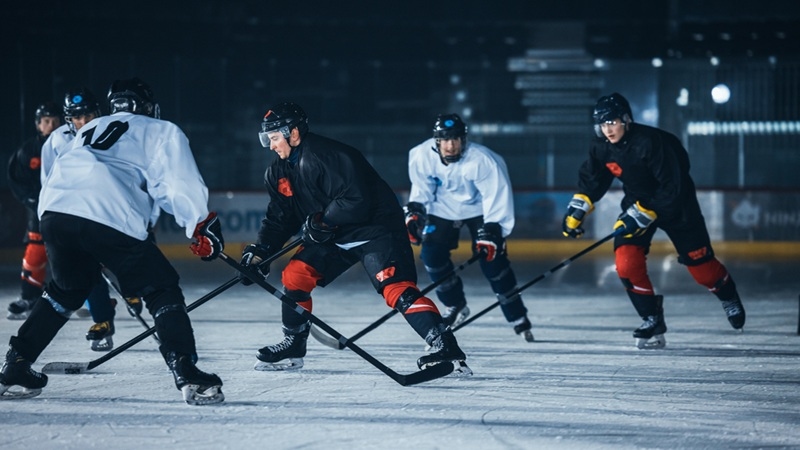
Ice hockey training drills are structured exercises that help players improve skating, puck control, and teamwork on the ice. These drills are the backbone of most training sessions because they build the skills players rely on during real matches. Coaches usually start with beginner hockey drills and then add hockey practice drills as players become more comfortable.
This blog can help you understand how regular practice drills can help players at different levels.
Must Read: Calf Training to Boost Hockey Speed Power & Stability
Ice hockey is a game that moves at a rapid pace. Players move swiftly on the ice, decisions arise in the blink of an eye, and slips occur frequently. This is exactly why these training drills are so vital. They enable the players to perform the same actions repeatedly until they feel natural.
During a game, there is no “pause” button to think about the next move. Players must skate, pass the puck, stop, turn, and perform all the actions naturally. Training drills help the players do all these actions naturally by “wiring” them into the brain.
There is another reason why these training drills are vital for the players: balance. Players can be powerful or speedy, but without balance on the ice, all these qualities mean little. Training enables the players to gain balance and stability on the ice. This enables them to move with confidence, understanding the responses of their bodies to any sudden change in speed or direction.
The 5 beginner hockey drills are listed in the following list:
This drill can look simple, and in many ways it is. Players skate from one end of the rink to the other while focusing on steady strides. The goal is not speed. The focus is balance. Beginners often struggle to keep their posture steady while skating. Their body may lean too far forward or backward. Practicing straight-line skating helps them understand how their body should move.
Handling the puck can feel difficult for beginners at first. The stick and puck must move together while the player continues skating. That coordination takes practice. Players move the puck gently from one side of the stick to the other while skating slowly forward in this drill. The focus is on smooth control rather than speed. Players may look down at the puck often at first.
Passing connects the entire team. Without good passes, the game becomes messy and slow. Two players stand a short distance apart and pass the puck back and forth in this drill. The emphasis is on clean, steady passes. Players try to keep the puck flat on the ice and aim directly at their teammate’s stick.
Turning quickly is part of nearly every hockey play. Players must change direction often, sometimes in tight spaces. The circle skating drill helps players practice controlled turns. Skaters move around marked circles on the ice while maintaining steady balance.
Hockey players constantly stop and accelerate again. Quick stops are important for defense and positioning. Players skate forward, stop firmly, and then push off again in this drill. The sequence repeats several times across the rink.
You can check the following list to understand the benefits of hockey practice drills:
As they practice consistently, they become better at gliding over the ice. They learn how to make their strides more smoothly and steadily, and they learn how to make the transition from speeding up or slowing down without losing their balance. Such skills will definitely be useful when the game is intense.
When the players are more confident in handling the puck, they have developed this skill by consistently practicing and honing their skills in handling the puck. They will be better at protecting the puck and keeping it under their control during fast breaks and in tight situations.
When the players practice, they are made aware of the situation in the game and are taught where they need to be and how they need to be. Thus, when they play the game, they become more aware of the situation and make better decisions.
Youth hockey training should focus on learning and enjoyment. Young players develop skills gradually, and training should support that process.
Young players benefit most from learning skating balance and puck control early. These skills support every other movement in hockey. Players improve faster as they grow when the basics are strong.
Younger players respond better to clear and simple instructions. Long explanations can confuse them. Short guidance helps players understand drills quickly and stay focused.
Training sessions should include passing and group drills. These activities help players understand teamwork and communication. Young athletes learn quickly when they practice together.
Basic hockey skills drills help players refine the small movements that affect overall performance.
Balanced skating helps players move efficiently across the ice. Practicing posture and stride control improves stability.
Stick handling drills help players guide the puck smoothly. This improves passing accuracy and puck protection.
Turning and stopping drills prepare players for sudden movements during matches.
Top Pick: What Is Hockey Sense & How Can You Develop It With Training?
A structured hockey practice routine helps players make the most of their training time.
Light skating and stretching prepare the body for practice.
Each practice session needs to work on the growth of the skills of the players.
Players can practice using what they have learned in game scenarios.
Team practice sessions can help the team members coordinate their skills better.
Light skating after practice helps the body cool down.
The practice sessions of ice hockey players revolve around developing speed in skates, mastering the puck, and playing in coordination with other team members. With continued practice, the players develop confidence and act swiftly during the matches. Organizing practice sessions is the key to the long-term development of the players.
They help beginners build strong skating balance and teamwork skills.
Regular practice sessions can help you to maintain and improve your skills steadily.
Most drills improve skating balance and passing accuracy.
This content was created by AI